
Community Spotlight #9: Alexandra Reed
January 27, 2026
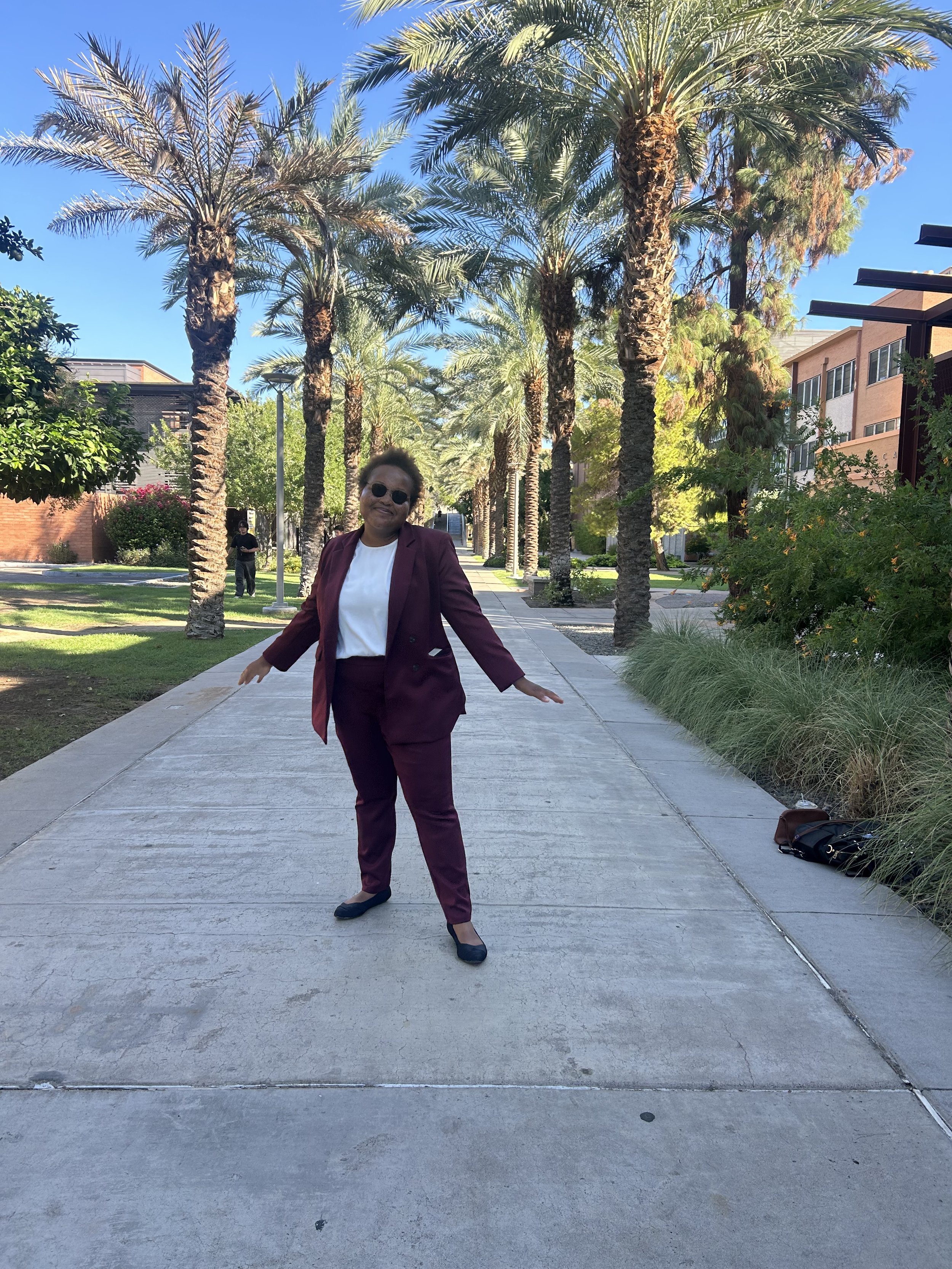
My name is Alexi Reed, and I am a PhD Candidate (and a dog mom of 2) in Biomedical Engineering at Arizona State University, where I study how to use movement as a biomarker for Alzheimer's disease and related dementias. My work primarily focuses on validating a novel performance-based test that leverages functional upper extremity movement to screen for preclinical Alzheimer's disease, but I'm also fascinated by gait speed and grip strength.
Tell us about your background.
I knew I wanted to be an engineer after my dad took me to the California State University, East Bay science fair in fifth grade, but figuring out what type of engineer I wanted to be took some time...and stumbling. I developed an interest in biomedical engineering and neurodegenerative diseases while in high school, where I was the primary caregiver for my grandfather who struggled with Parkinson's disease and dementia while living in a low-income area. Whenever I drove him to his appointments at the West LA Veteran's Hospital (~2hrs one way), I always wondered what could be done to fix it. Despite this underlying interest, I ultimately decided to pursue Chemical Engineering at California State University Long beach dude to the connections I made with faculty during my admitted students visit who encouraged me to utilize my chemistry interest to advance technology. I eventually reconnected with my interest in biomedical engineering while participating in summer research for the Ronald E. McNair Post-baccalaureate Achievement Program, which confirmed that I wanted to pursue a PhD in Biomedical Engineering to develop clinical tools for neurodegenerative diseases that can break through socioeconomic barriers to healthcare. After doing research at Purdue University and the University of Michigan, I found my way to Arizona State University to work with Dr. Sydney Schaefer, where I'm now doing the work I've wanted to do since high school: making neurodegenerative disease screening more accessible. Now, as a 3rd year PhD candidate, my research focuses on advancing a novel, brief performance-based test that can detect cognitive and functional decline in the preclinical stages of Alzheimer's disease. By leveraging large observational cohorts here in the Arizona Alzheimer's Consortium, I'm able to evaluate how this test is associated with new blood-based biomarkers of Alzheimer's disease and even neuro-imaging biomarkers. This research will hopefully advance the test toward widespread implementation in clinical or community care settings.
What sparked your interest in learning data science?
I have always wanted to streamline my data analyses and make effective figures, but I was almost averse to coding after my exposure to MATLAB in my undergraduate coursework as a chemical engineering major. I kept putting off giving data science a try because of my MATLAB trauma, but once I became a learner with ReproRehab, I discovered data science isn't just coding and it doesn't have to be a traumatic experience! It's really about making your work accessible and reproducible so that science can advance forward, which completely changed my perspective.
What are you most excited about ReproRehab?
What excites me most about being part of ReproRehab is seeing everyone's growth, mine included. Having transitioned from a learner to a TA, I can now help others develop their data science skills and provide more support when the going gets tough (AKA when their code won't run). It's also exciting seeing the program grow and being a part of our scientific pyramid scheme; I enjoy watching people soak up all the data science and reproducibility principles, and then shout it from the mountain tops so that we get more people each year to either apply or just try to adopt these principles on their own. Being a part of ReproRehab has been extremely rewarding and empowering, and I'm forever grateful.
What advice would you give to someone who wants to follow a similar path?
Don't count yourself out; you have to be resilient and persistent. Learning data science and implementing reproducible best practices takes a lot of time. You will make mistakes, things will not work the first (or second or third....) time, but its all about trying again. As corny as it sounds, it's not about how many times you fall, it's about how many times you get back up. ReproRehab has an entire database to help and you can always ask other people in the program for support, too - especially other learners.
Anything you are passionate about outside of ReproRehab?
Outside of data science and ReproRehab, I have an unhealthy coffee obsession - like any time I can try a new or different coffee shop or experiment with my coffee gadgets at home, I will. I also love to read; I've been an avid reader for as long as I can remember. I vividly remember my dad reading Harry Potter and the Goblet of Fire to me as a kid and getting so frustrated with how slow he was reading, that I took the book and started reading it myself. I'm also a huge foodie and love trying different cuisines, but as a broke graduate student, my foodie adventures are currently on hold.
Anything else you would like to share? (website/GitHub/podcast)
I'm not cool enough for a podcast, but connect with me on LinkedIn or follow my Instagram page. https://www.linkedin.com/in/alexandra-reed-08916 https://instagram.com/lexthephdstudent

